
The World Bank puts global account ownership at 79% of adults and mobile phone ownership at 86%, while 1.3 billion adults still hold no account at all. 42% of that excluded group already owns a smartphone. The distribution problem and the device problem stopped being the same problem some time ago, and what has changed since is that a first financial relationship no longer has to begin and end at a bank.
The Cohort That Never Walked Into a Branch
Financial inclusion policy has generally treated the bank account as the entry point, with savings, credit and investment following as later steps taken from inside the system. That sequence made sense when a domestic institution was the only place a balance could safely sit.
It stops being a sequence at all once a phone can hold a dollar-denominated balance that settles globally, because the steps can then be taken in any order or skipped entirely. Whether that is actually happening is an empirical question rather than a philosophical one, and it is answered by the order in which people arrive.
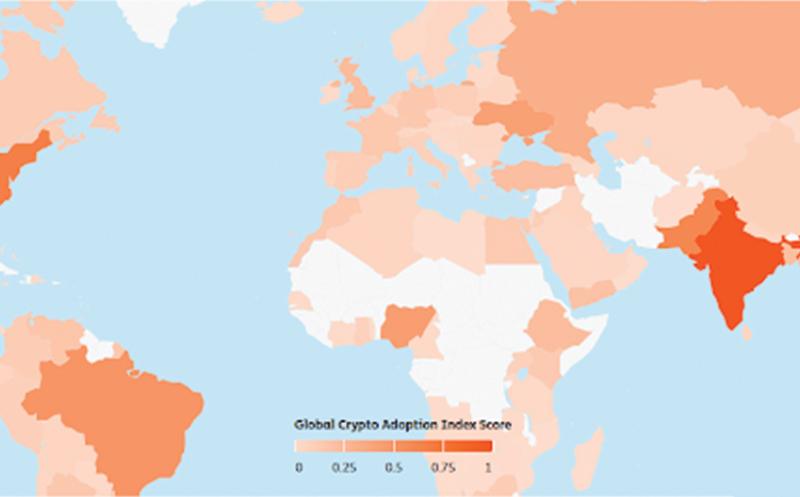
Chainalysis ranks India first, the United States second, Pakistan third and Vietnam fourth in its 2025 adoption index, with on-chain value received across Asia-Pacific up 69% year over year to $2.36 trillion, Latin America up 63% and Sub-Saharan Africa up 52%. The GSMA recorded mobile money passing $2 trillion in transactions in 2025, which is the precedent worth holding onto: a financial rail that scaled across these same markets without waiting for branch networks that were never going to be built.
“The financial platform of the next era is already taking shape. Crypto-native infrastructure, traditional assets, stablecoins, payments, savings and intelligent AI protection are beginning to come together in one always-on system,” says Eowyn Chen, Interim Chief Marketing Officer at Binance. “The future is not crypto replacing traditional finance, or traditional finance absorbing crypto. It is the two converging to give people more access, more protection and more power over their financial lives. Eventually, people may stop describing that experience as crypto. They will simply call it finance.”
An account that is someone’s first financial relationship rather than an addition to an existing one adds to the system rather than redistributing within it. That distinction is what separates inclusion data from market share, and it is measurable.
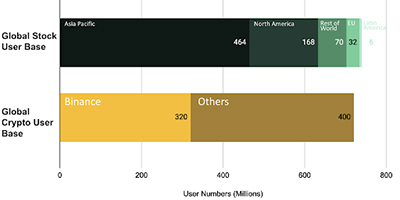
The demographics look nothing like a legacy brokerage. More than 90% of Binance’s equity users are based in emerging markets. 41.5% of its tokenized-securities users began their traditional finance journey through that product, having traded neither equities nor perpetual futures on the platform beforehand, and Gen Z accounts for 44% of that activity.
Binance Research estimates roughly 700 million brokerage accounts worldwide, leaving close to 89% of the global population without meaningful access to the largest equity market there is. Against that, the pattern reads as a door opening rather than a market shifting. First-time investors arriving through a venue that also offers leverage is a supervision question as much as an inclusion result.
What Frictionless Dollar Access Also Does
The most serious objection comes from the institutions that have to manage the macroeconomic consequences. Speaking at the University of Cape Town on August 7—IMF First Deputy Managing Director Dan Katz set out how frictionless foreign-currency access changes the calculus for emerging markets.
Households and firms adopt dollarization to protect against inflation and depreciation. But once entrenched it proves highly persistent even after the conditions that triggered it subside and it constrains monetary policy space for years afterward.
What distinguishes stablecoins is speed and reach. Currency substitution previously spread through physical cash, domestic dollar deposits or offshore accounts, all of which took time and left a trail. Smartphones and messaging apps compress that, and they reach countries where conventional dollar access is restricted entirely.
The specific mechanisms Katz identified are worth naming. Capital flow management measures were designed around regulated intermediaries, and on-chain conversion between local-currency and dollar stablecoins moves the on-ramp outside that perimeter. Unhosted wallets widen the gap further, because there is no legal entity for a supervisor to engage with. Large inflows can also open a spread between the stablecoin price and the official exchange rate, producing something close to a parallel market—the IMF puts the effective cost of a $200 stablecoin transfer anywhere from negative 2% to 8% depending on the corridor, since in some markets dollar stablecoins trade at a premium.
That premium is itself a demand signal. Chainalysis recorded Sub-Saharan Africa’s monthly on-chain volume jumping to nearly $25 billion during the March 2025 naira devaluation, with stablecoins now accounting for roughly 43% of regional on-chain volume. Stablecoins make up over half of exchange purchases in Argentina and Brazil, and Turkey’s gross cryptocurrency inflows reached roughly $878 billion by mid-2025.
Katz’s own framing is more balanced than the headline risk suggests. The impact depends heavily on country circumstances: in already-dollarized economies, stablecoins largely substitute for foreign currency people were holding anyway rather than adding to it. His strongest recommendation is credible domestic macroeconomic policy rather than restriction, and he concedes the upside directly, noting that competition from stablecoins can bring down the cost of sending money home.
Access Was the Variable
The adoption data settles one long-running argument. Demand for financial access outside the banking system was real, and the constraint was distribution rather than appetite. It opens a considerably harder one about what a supervisor does when the account holding a household’s savings sits outside their jurisdiction and outside their statutory reach. Both things are true at once, and policy frameworks built for a world where the first financial step happened in a branch will have to account for one that happens on a screen.